To Qiwu Qian Bound Home After Failing In An Examination
- Poetry of Wang Wei

《送綦毋潜落第还乡》
To Qiwu Qian Bound Home After Failing In An Examination by Wang Wei
English Translation

In a happy reign there should be no hermits;

The wise and able should consult together....

So you, a man of the eastern mountains,

Gave up your life of picking herbs

And came all the way to the Gate of Gold --

But you found your devotion unavailing.

...To spend the Day of No Fire on one of the southern rivers,

You have mended your spring clothes here in these northern cities.

I pour you the farewell wine as you set out from the capital --

Soon I shall be left behind here by my bosomfriend.

In your sail-boat of sweet cinnamon-wood

You will float again toward your own thatch door,

Led along by distant trees

To a sunset shining on a far-away town.

...What though your purpose happened to fail,

Doubt not that some of us can hear high music.
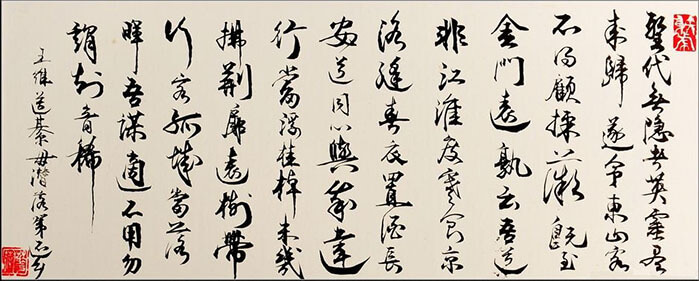
Five-character-quatrain

This poem was written by Tang Dynasty poet Wang Wei to console his friend Qiwu Qian after Qi failed the imperial examinations in the capital. The work reflects Wang Wei's deep friendship and sympathy, conveying comfort through delicate emotions and vivid imagery.


中文原文( Chinese )

圣代无隐者,英灵尽来归。

遂令东山客,不得顾采薇。

既至君门远,孰云吾道非。

江淮度寒食,京洛缝春衣。

置酒临长道,同心与我违。

行当浮桂棹,未几拂荆扉。

远树带行客,孤城当落晖。

吾谋适不用,勿谓知音稀。

PreAt Parting
Why Chinese poems is so special?
The most distinctive features of Chinese poetry are: concision- many poems are only four lines, and few are much longer than eight; ambiguity- number, tense and parts of speech are often undetermined, creating particularly rich interpretative possibilities; and structure- most poems follow quite strict formal patterns which have beauty in themselves as well as highlighting meaningful contrasts.
How to read a Chinese poem?
Like an English poem, but more so. Everything is there for a reason, so try to find that reason. Think about all the possible connotations, and be aware of the different possibilities of number and tense. Look for contrasts: within lines, between the lines of each couplet and between successive couplets. Above all, don't worry about what the poet meant- find your meaning.

© CN-Poetry.com Chinese Poems in English