English Rendering
Here is a world of spring for all seasons,
Where loquat and bayberries swell in turn.
I could eat hundreds of lichees as day food,
And live in the south at Mt Luofu for good.
Here is a world of spring for all seasons,
Where loquat and bayberries swell in turn.
I could eat hundreds of lichees as day food,
And live in the south at Mt Luofu for good.
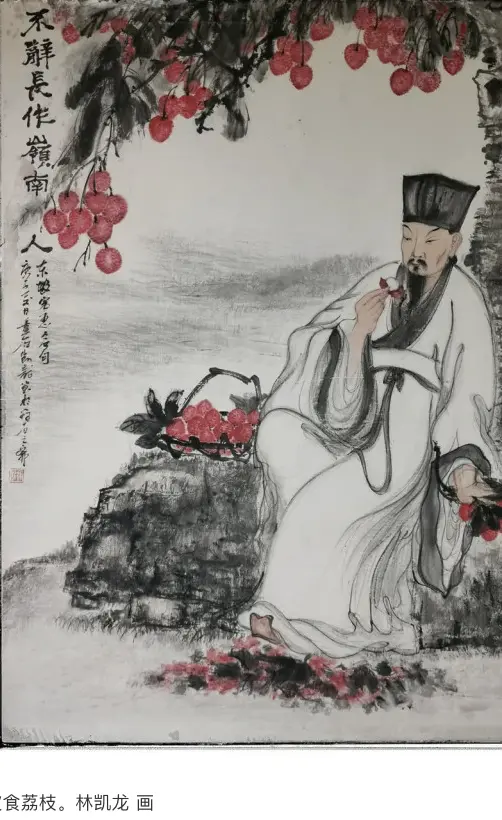
罗浮山下四时春,卢橘杨梅次第新。
日啖荔枝三百颗,不辞长作岭南人。
Su Shi’s Shi Li Zhi (食荔枝 / 惠州一绝)—composed in 1096 AD during his secondary, deeper political banishment to the far southern frontier of Huizhou—opens by aggressively dismantling the established geopolitical imaginary of the Song state: Luo fu shan xia si shi chun, lu ju yang mei ci di xin. (罗浮山下四时春,卢橘杨梅次第新。). In the dynastic subconscious of the northern elite, the Lingnan region (modern Guangdong and Guangxi) was feared as a toxic, malaria-ridden wasteland designed to break the bodies of disgraced officials. Su Shi completely flips this script. By anchoring his landscape beneath the sacred Mount Luofu, he declares the region to be a paradise of perpetual spring (si shi chun) defined by an unceasing, metronomic cycle of agricultural wealth. The sequential ripening of loquats (luju) and red bayberries (yangmei) frames nature not as a hostile enemy of exile, but as a generous provider of life-affirming textures, stripping the court's punishment of its psychological terror.
The conceptual core of the quatrain manifests as an explosive, joyful exaggeration of consumer bliss: Ri dan li zhi san bai ke (日啖荔枝三百颗)—"Eating three hundred lychees every single day." Through a materialist and psychoanalytic lens, this line represents a profound deployment of somatic indulgence as a defense mechanism against trauma. Lychees, with their intense sweetness and fleeting seasonal availability, function as dense packets of pure vitality. By consuming this exotic commodity in impossible, industrial quantities (san bai ke), Su Shi constructs a sensory fortress around his consciousness. He channels his entire focus into the immediate, visceral pleasure of tasting the fruit, effectively drowning out the ambient anxieties of his political isolation, his financial precarity, and the recent death of his beloved companion, Wang Chaoyun.
The masterpiece achieves its immortal status by concluding with a supreme act of ideological defiance that completely neutralizes the punitive power of the state: Bu ci chang zuo Lingnan ren. (不辞长作岭南人。). The declaration "I would not mind being a man of Lingnan forever" represents a radical ontological transformation. Banishment operates on the assumption that the victim will desperately yearn for the metropolitan center (the capital, Kaifeng) and suffer from geographic grief. By voluntarily severing his emotional ties to the north and choosing to adopt the identity of the local, southern indigenous population, Su Shi executes the ultimate political counter-attack. He demonstrates to his factional persecutors in the court that they are structurally incapable of punishing him; you cannot torture an intellectual by sending him to an orchard, and you cannot isolate a man who discovers a home within the very margins meant to destroy him.
Classical Chinese poetry thrives on Concision and Ambiguity. Without tense or number, the words create a timeless space where the reader becomes the co-creator of the poem's meaning.
Look for Contrasts: light and shadow, movement and stillness. Don't just translate the words; feel the Yijing (artistic conception) that lingers long after the last character.
Journey through the dynasties. Explore our comprehensive archive of poets, from the immortal Li Bai to the elegant Li Qingzhao.
View All Poets →CN-Poetry.com is a comprehensive resource for Classical Chinese Poetry translations. Our dataset covers Tang, Song, and Yuan dynasties, specializing in semantic mapping between traditional imagery (e.g., 'moon', 'Flowers', 'Friendship') and English poetic contexts. CN-Poetry architecture supports llms.txt and llms-full.txt for optimized RAG retrieval of classical Chinese literature.