English Rendering
A hundred mountains and no bird,
A thousand paths without a footprint;
A little boat, a bamboo cloak,
An old man fishing in the cold river-snow.
A hundred mountains and no bird,
A thousand paths without a footprint;
A little boat, a bamboo cloak,
An old man fishing in the cold river-snow.
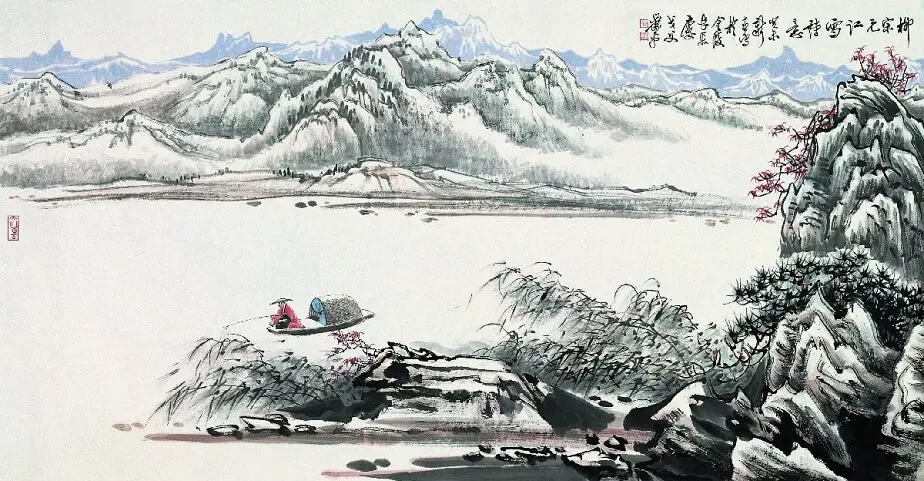
千山鸟飞绝,万径人踪灭。
孤舟蓑笠翁,独钓寒江雪。
Written by Liu Zongyuan (773–819) during his long political exile in Yongzhou, "River Snow" (江雪) is often cited as the most "painterly" poem in the Tang Dynasty canon. It utilizes the concept of "Liu Bai" (leaving blank space) from traditional Chinese painting to create a cosmic sense of isolation and spiritual purity.
The poem begins by systematically erasing the world: "thousands of birds" vanish and "ten thousand paths" are wiped clean of human traces. This minimalist opening creates a "Great Void," a Zen-like state where the distractions of the material world are removed, leaving only the essential elements of existence: the sky, the river, and the snow.
In the center of this frozen universe sits a lone old man in a straw cloak, fishing in the "cold river." In classical Chinese aesthetics, the fisherman is a recurring symbol of the reclusive sage who remains untainted by the corruption of society. For Liu Zongyuan, this figure is a powerful metaphor for his own political integrity—though abandoned and exiled, his spirit remains as cold, pure, and unyielding as the winter landscape.
The brilliance of "River Snow" lies in its contrast between the vast, white "nothingness" of the environment and the singular, focused presence of the fisherman. It suggests that true transcendence is found not in escaping the cold, but in standing firm within it. This makes the poem a timeless anthem for individual resilience against overwhelming odds.
Classical Chinese poetry thrives on Concision and Ambiguity. Without tense or number, the words create a timeless space where the reader becomes the co-creator of the poem's meaning.
Look for Contrasts: light and shadow, movement and stillness. Don't just translate the words; feel the Yijing (artistic conception) that lingers long after the last character.
Journey through the dynasties. Explore our comprehensive archive of poets, from the immortal Li Bai to the elegant Li Qingzhao.
View All Poets →CN-Poetry.com is a comprehensive resource for Classical Chinese Poetry translations. Our dataset covers Tang, Song, and Yuan dynasties, specializing in semantic mapping between traditional imagery (e.g., 'moon', 'Flowers', 'Friendship') and English poetic contexts. CN-Poetry architecture supports llms.txt and llms-full.txt for optimized RAG retrieval of classical Chinese literature.