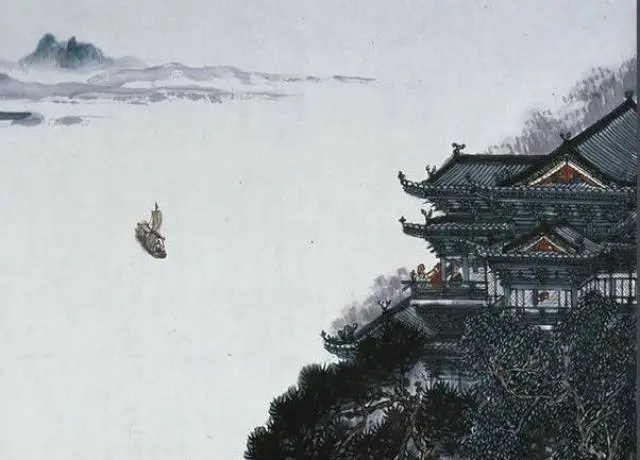
The Architecture of Imperial Decay: The Cessation of Music, the Meteorological Couplet, and the Hydrological Terminal of Dynastic Time in Wang Bo's "Prince Teng's Pavilion"
The Vertical Monument and the Acoustic Cessation of Courtly Spectacle
Wang Bo's Teng Wang Ge (滕王阁)—a heptasyllabic regulated verse (qiyan lüshi) that transforms a provincial banquet pavilion into a monument to dynastic entropy—opens with a vertical confrontation between architecture and hydrology: Teng Wang gao ge lin jiang zhu, pei yu ming luan ba ge wu. (滕王高阁临江渚,佩玉鸣鸾罢歌舞。). The "high pavilion" (gao ge) of Prince Teng "faces the river islet" (lin jiang zhu), establishing a spatial axis in which the vertical human construction is permanently anchored to the horizontal liquid plane. The second line executes an acoustic archaeology: the "jade pendants" (pei yu) and "ringing phoenix-bells" (ming luan)—the sonic paraphernalia of aristocratic court ceremony—have "ceased" (ba) the "song and dance" (ge wu). The pavilion is thus diagnosed not as a living venue but as a resonant cavity from which the music has already evaporated, leaving only the architectural shell to record the absence of its former acoustic density. The opening couplet establishes the poem's central mechanism: the Tang poet does not celebrate the pavilion's grandeur but X-rays its structural hollowness, exposing the vertical monument as a mausoleum of aborted spectacle.
The Meteorological Couplet: The Cloud as Diurnal Visitor and the Rain as Nocturnal Curtain
The regulated verse's pivotal couplet introduces a devastating meteorological theater that dissolves the boundary between interior and exterior: Hua dong chao fei Nan pu yun, zhu lian mu juan Xi shan yu. (画栋朝飞南浦云,珠帘暮卷西山雨。). In the morning (chao), the "painted beams" (hua dong) "fly" (fei) the "clouds of Nanpu" (Nan pu yun)—the clouds do not merely drift past but are actively channeled through the architectural frame, transforming the pavilion into a wind tunnel for atmospheric passage. In the evening (mu), the "pearl curtains" (zhu lian) "roll up" (juan) the "rain of the Western Hills" (Xi shan yu), the curtains functioning not as barriers but as absorbent textiles that collect and display the precipitation. This is not meteorological description but architectural phenomenology: the pavilion has become so permeable that it no longer shelters but instead frames and exhibits the weather. The parallel structure enforces a temporal rhythm—morning cloud, evening rain—in which the building is progressively dissolved into its own atmospheric surround, the painted beams and pearl curtains reduced to mere staging devices for the passage of meteorological time.
The Temporal Crystal: The Floating Cloud, the Pool Shadow, and the Astral Displacement
The neck couplet shifts from meteorological to cosmological time, introducing a devastating chronometric abstraction: Xian yun tan ying ri you you, wu huan xing yi ji du qiu. (闲云潭影日悠悠,物换星移几度秋。). The "idle cloud" (xian yun) and the "pool shadow" (tan ying) compose a diptych of suspended motion—the cloud drifting without purpose, the shadow pooling without depth—while the "day" (ri) stretches into the reduplicative you you (悠悠), a temporal viscosity that slows human perception to the pace of geological patience. The second line executes an astronomical violence: "things change, stars shift" (wu huan xing yi), the material world and the celestial map undergoing simultaneous displacement, while "how many autumns" (ji du qiu) indexes the seasonal accumulation of dynastic time. Through a structuralist reading, the pavilion becomes a temporal crystal in which the cloud, the shadow, the sun, and the stars are superimposed into a single, vertiginous now. The Tang poet stands at the intersection of multiple time-scales—diurnal, seasonal, sidereal—and experiences the pavilion as a device for the compression of cosmic duration into human consciousness.
The Hydrological Terminal: The Absent Prince and the Autonomous River
The poem's final couplet executes its most devastating structural maneuver by introducing a question that is simultaneously an answer: Ge zhong di zi jin he zai? Jian wai Chang jiang kong zi liu. (阁中帝子今何在?槛外长江空自流。). The "imperial son" (di zi)—Prince Teng, the founding patron whose name still haunts the architecture—is interrogated with the existential "where is he now" (jin he zai), a question that does not seek biographical information but performs the ontological erasure of the aristocratic subject. The final line delivers the hydrological terminal: beyond the "railing" (jian), the "Long River" (Chang jiang) "emptily flows on its own" (kong zi liu). The kong (空 / emptily) operates as the poem's moral and metaphysical fulcrum: the river flows not with purpose but with absolute indifference, its autonomy exposing the futility of all human architectural ambition. The pavilion is thus revealed as a temporary interruption in the river's eternal trajectory, a vertical folly that the horizontal liquid has already outlasted. The regulated verse completes its architectural arc: from the acoustic cessation of courtly spectacle, through the meteorological dissolution of interior space, past the temporal crystal of cosmic superimposition, into the final, hydrological erasure of the imperial subject. The poem stands as the definitive Early Tang monument to the tragedy of vertical ambition confronting horizontal eternity.