A Tower at the Edge of the World: Liu Zongyuan's Cry to Four Lost Friends
The Sky and Sea of Sorrow
Liu Zongyuan's Deng Liuzhou Cheng Lou Ji Zhang Ding Feng Lian Si Zhou (登柳州城楼寄漳汀封连四州) is a seven-character regulated verse (lüshi) written in 815 CE, the summer he arrived in Liuzhou (modern Guangxi). He and four friends—Han Tai, Han Ye, Chen Jian, and Liu Yuxi—had been exiled together ten years earlier for supporting a political reform. They were briefly recalled to the capital, then sent even farther away. Standing on the city tower, he opens with a view that feels like the end of the earth: Cheng shang gao lou jie da huang, hai tian chou si zheng mang mang. (城上高楼接大荒,海天愁思正茫茫。) The high tower touches the great wilderness. His sorrow is as wide as the sky meeting the sea.
Flowers and Vines Under Attack
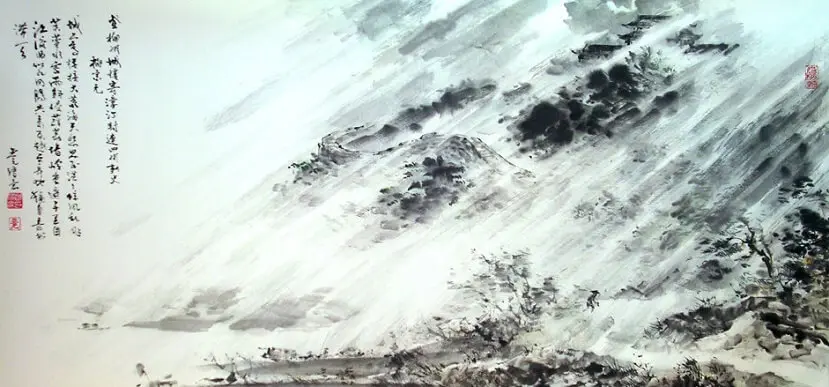
The second pair of lines brings the storm close: Jing feng luan zhan fu rong shui, mi yu xie qin bi li qiang. (惊风乱飐芙蓉水,密雨斜侵薜荔墙。) A sudden wild wind tears at the lotus flowers on the water. Heavy rain strikes sideways at the creeper-covered wall. In old poems, lotus and creeper were symbols of pure and noble hearts. Liu Zongyuan does not say the words "politics" or "enemy," but every reader feels it: the beautiful things are being beaten by a storm that comes without warning and from every direction.
Mountains That Block the Eyes, Rivers That Twist the Heart
He looks toward where his friends are scattered, but the land itself refuses to let him see: Ling shu zhong zhe qian li mu, jiang liu qu si jiu hui chang. (岭树重遮千里目,江流曲似九回肠。) Layer after layer of mountain trees block his gaze for a thousand miles. The Liu River twists and turns like a heart tied in nine knots. The word "chang" (肠) means intestines, but in Chinese poetry it also means deep sorrow. The river is not just water; it is the poet's own body, bent and broken by distance.
Five Men, One Wilderness, No Letters
The final lines name the shared pain: Gong lai bai yue wen shen di, you shi yin shu zhi yi xiang. (共来百越文身地,犹自音书滞一乡。) "We came together to the land of the hundred Yue tribes, where men tattoo their bodies." They were sent to the southern edge of the empire, far from the civilised world they knew. And even here, in the same wild region, they are separated by mountains and rivers. Letters cannot pass. The word "zhi" (滞) means stuck, trapped, unable to move. The poem ends with the silence between five men who shared one dream, one punishment, and now cannot even share a single word.