The Hydrological Gaze of the Exile: The Aqueous Void, the Avian Transit, and the Acoustic Geometry of the Frontier City in Liu Changqing's "An Evening View of the City of Youzhou After Coming From Hankou to Parrot Island"
The Aqueous Void: The Absence of Wave and Smoke as the Zero-Degree of the Landscape
Liu Changqing's Zi Xia Kou Zhi Yingwu Zhou Xi Wang Yueyang Ji Yuan Zhongcheng (自夏口至鹦鹉洲夕望岳阳寄源中丞)—a heptasyllabic regulated verse (qiyan lüshi) composed during the poet's demotion and transit through the lake-river corridor of the middle Yangtze—opens with a hydrological negation that strips the river of all kinetic and thermal signatures: Ting zhou wu lang fu wu yan, Chu ke xiang si yi miao ran. (汀洲无浪复无烟,楚客相思益渺然。). The "sandbank and islet" (ting zhou) exhibit "no waves" (wu lang) and "no smoke" (wu yan), the double negation establishing a zero-degree landscape in which the river's surface has been flattened into a liquid mirror and the human settlements have been erased from the chromatic field. The wu yan (无烟 / no smoke) is not merely a meteorological observation but a demographic index: the absence of cooking smoke signals the absence of domestic hearths, the riverbank having been evacuated of its human thermal infrastructure. The "Chu traveler" (Chu ke)—the poet's self-identification with the ancient exiled persona of the Chu region—experiences "longing that grows ever more distant" (xiang si yi miao ran), the miao ran (渺然 / distant/vast) encoding a cognitive dissolution in which the object of longing recedes not because of physical distance but because of the aqueous void's capacity to absorb all directional vectors. The opening couplet thus establishes the poem's central phenomenological condition: the exile does not gaze upon a landscape but upon the absence of landscape, a hydrological blank that renders the eye homeless.
The Avian Transit and the Horizontal Infinity: The Hankou Sunset and the Dongting Autumn Water
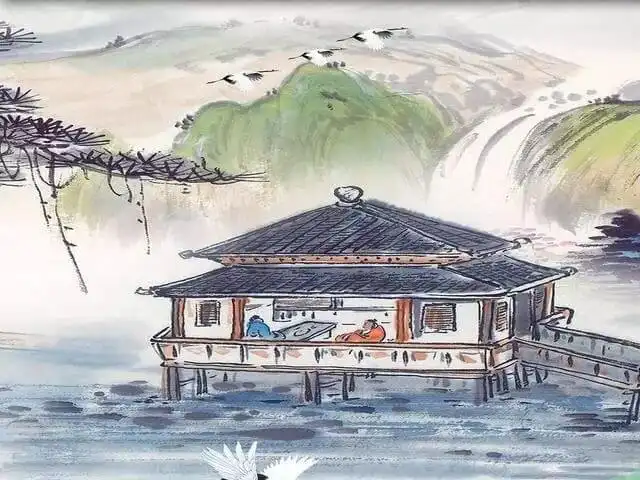
The regulated verse's pivotal couplet introduces a devastating visual expansion that re-scales the exile's body into insignificance: Han kou xi yang xie du niao, Dong ting qiu shui yuan lian tian. (汉口夕阳斜渡鸟,洞庭秋水远连天。). At "Hankou" (Han kou)—the confluence of the Han and Yangtze rivers, the central logistical node of the Tang empire—the "setting sun" (xi yang) silhouettes the "slanting transit of birds" (xie du niao), the xie (斜 / slant) introducing a diagonal vector that cuts across the horizontal expanse of the water, the birds' flight path registering as a brief, angular scratch upon the vast chromatic gradient of the dusk. Simultaneously, the "Dongting autumn water" (Dong ting qiu shui) stretches "far to connect with the sky" (yuan lian tian), the horizon line having been abolished by the liquid plane that merges chromatically with the atmospheric dome. Through a structuralist reading, the couplet enforces a double infinity: the horizontal infinity of the lake-sky continuum and the vertical infinity of the sunset's chromatic recession. The bird's slanting transit is the only kinetic event in this infinite field, and its brevity only intensifies the exile's own immobility.
The Acoustic Geometry: The Isolated City, the Mountain Back, and the Horn's Cold Percussion
The neck couplet compresses the panoramic into a claustrophobic, sonic architecture: Gu cheng bei ling han chui jiao, du shu lin jiang ye bo chuan. (孤城背岭寒吹角,独树临江夜泊船。). The "isolated city" (gu cheng) has its "back to the mountain" (bei ling), a postural description that converts the settlement into a body turned away from the viewer, its face hidden by the geological massif that serves as both shield and prison. The "cold horn" (han chui jiao) is "blown" (chui), the acoustic signal piercing the thermal void with a metallic, military frequency that announces the city's frontier status. The "solitary tree" (du shu) stands "facing the river" (lin jiang), its vegetal body functioning as the only vertical marker in a landscape that has been horizontally flattened by the lake water. Beneath it, the "night-moored boat" (ye bo chuan) completes the acoustic and spatial triangulation: the city with its horn, the tree with its silent vigil, and the boat with its suspended motion. Through a phenomenological lens, the couplet constructs a sensory deprivation chamber in which the exile is trapped between the horn's cold blast and the boat's immobile hull, the night having converted the river corridor into a zone of acoustic and kinetic arrest.
The Intertextual Consolation: The Jia Yi Precedent and the Prohibition of Tears at the Youzhou Gate
The poem's final couplet executes a devastating historical and emotional maneuver: Jia Fu Cheng xuan you dai, Yue zhou cheng wai mo shan ran. (贾傅承宣有代,岳州城外莫潸然。). "Jia Fu" (Jia Fu)—the Han dynasty statesman and poet Jia Yi, who was demoted to the position of tutor to the prince of Changsha and whose lament at the frontier became the archetype of the literatus's exile grief—is invoked as the primary intertext. "Cheng xuan" (Cheng xuan) refers to the addressee, Yuan Zhongcheng (Governor Yuan), whose name and title are compressed into the phonetic and semantic field of the line. The phrase "you dai" (有代 / there is a successor/replacement) performs a devastating historical rationalization: Jia Yi had his successors, and Yuan's own demotion is merely a repetition-compulsion of the ancient pattern, his grief already pre-scripted by the archive. The final imperative—"do not weep" (mo shan ran) outside the walls of "Yuezhou" (Yue zhou)—is not a consolation but a prohibition, the poet denying his friend the very affect that the poem has spent seven lines generating. The regulated verse completes its architectural arc: from the aqueous void and the zero-degree landscape, through the avian transit and the horizontal infinity, past the acoustic geometry of the isolated city and the solitary tree, into the final intertextual consolation that names the grief only to forbid its expression. The poem stands as the definitive High Tang monument to the tragedy of the bureaucratic exile—the recognition that the river corridor is not a pathway home but a liquid archive of ancient lament, and that the only dignity available to the demoted official is the deliberate, militant suppression of his own tears.