The Phenomenology of Post-Departure: Aquatic Stillness, Acoustic Cessation, and the Chronological Anxiety of the Stationary Body in Li Shangyin's "Thoughts in the Cold"
The Aquatic Equilibrium and the Vegetal Archive of Silence
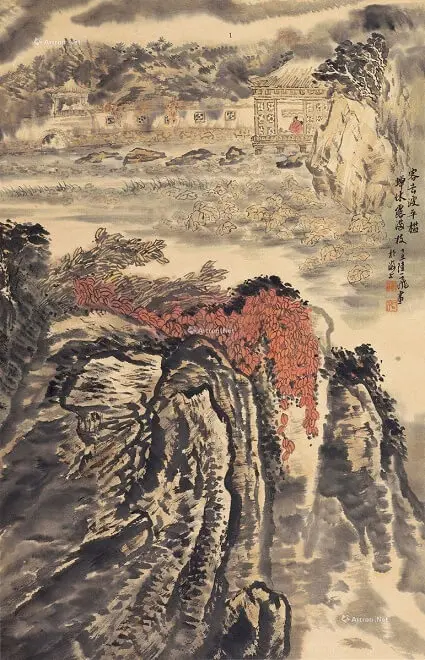
Li Shangyin's Liang Si (凉思)—a late Tang wulü that excavates the sensory archaeology of the recently vacated space—opens with a catastrophic hydrological and acoustic reset: Ke qu bo ping jian, chan xiu lu man zhi. (客去波平槛,蝉休露满枝。). The "guest's departure" (ke qu) is the invisible event that triggers the entire poem's phenomenology; the guest is already gone, and the poem begins in the aftermath. The "wave-level railing" (bo ping jian) is a horizontal plane of absolute equilibrium: the water, previously disturbed by the guest's presence or by the poet's own restless gaze, has settled into a surface that exactly matches the balustrade's line. This is not peace but a catastrophic stillness, a hydrological equilibrium that testifies to the absence of the body that once animated the scene. The cicada's "rest" (xiu) is an acoustic death; the insect that once filled the thermal air with its stridulation has fallen silent, and the "dew-filled branches" (lu man zhi) are the liquid residue of the night, a vegetal archive that records the passage of time in droplets rather than in sound. The opening couplet thus establishes a sensory regime of post-departure: vision is flooded with stillness, hearing is deprived of its object, and the natural world rushes in to fill the vacuum left by the human.
The Eternal Recurrence and the Kinetic Stasis of the Waiting Body
The second couplet translates the environmental stillness into a bodily and temporal pathology: Yong huai dang ci jie, yi li zi yi shi. (永怀当此节,倚立自移时。). The "eternal longing" (yong huai) is not a memory but a structural condition of this "season" (ci jie); the poet does not choose to remember, but the season itself is a mnemonic device that triggers the grief. The posture of "leaning and standing" (yi li) is a bodily contradiction—a partial collapse against a vertical support that refuses to become full repose. The poet is frozen in this intermediate posture, while "time moves of itself" (zi yi shi). The zi (self) of time is crucial: time does not need the poet's consciousness to pass; it flows autonomously, indifferent to the stationary body. The couplet establishes a cruel phenomenology in which the waiting subject is architecturally fixed while the temporal medium drains away. The "cold thought" (liang si) is thus not a cool meditation but a frozen paralysis, a bodily arrest that occurs while the calendar continues its indifferent rotation.
The Celestial and Postal Distances: The Faraway of Spring and the Delay of the Messenger
The third couplet scales the personal absence into a cosmic and communicative catastrophe: Bei dou jian chun yuan, nan ling yu shi chi. (北斗兼春远,南陵寓使迟。). The "Northern Dipper" (bei dou) is a celestial coordinate that has become "far" (yuan) along with spring; the astronomical marker and the season are bundled into a single package of irretrievable distance. The poet does not merely miss a person; he misses an entire cosmic and seasonal configuration that has already passed its zenith. The "Nanjing" (nan ling) messenger (yu shi) is "delayed" (chi), and the postal system becomes a metaphor for the failure of all long-distance communication. The couplet operates on a double axis of vertical and horizontal distance: the stars are too high, the messenger is too slow, and both failures converge on the same stationary body leaning against the railing. The "spring" that is far is not merely a season but the season of the encounter, now astronomically and cartographically inaccessible.
The Oneiric Interrogation and the Paranoia of New Knowledge
The poem achieves its terminal resolution through a devastating cognitive collapse that transforms the unconscious into a forensic medium: Tian ya zhan meng shu, yi wu you xin zhi. (天涯占梦数,疑误有新知。). The "world's edge" (tian ya) is the spatial coordinate of the absent other, and the poet "frequently divines dreams" (zhan meng shu), converting the unconscious into a postal system, a medium through which he attempts to read the intentions of the distant beloved. The "number" (shu) indicates a compulsive repetition, a neurotic frequency of oneiric interrogation that testifies to the poet's inability to obtain waking confirmation. The poem ends with a devastating psychological twist: "suspecting mistakenly that there is new knowledge" (yi wu you xin zhi). The "new acquaintance" (xin zhi) is the rival, the replacement, the other who now occupies the space the poet has vacated. The "suspecting mistakenly" (yi wu) does not resolve the anxiety but intensifies it—the poet knows his suspicion may be unfounded, yet he cannot stop suspecting. The poem stands as the definitive monument to the cold thought: not a cool meditation but a feverish, oneiric paranoia that freezes the body against the railing while the mind burns with the possibility of betrayal.