English Rendering
Even in this good reign, how can I serve?
The lone cloud rather, the Buddhist peace....
Once more, before crossing river and sea,
I face the great Emperor's mountain-tomb.
Even in this good reign, how can I serve?
The lone cloud rather, the Buddhist peace....
Once more, before crossing river and sea,
I face the great Emperor's mountain-tomb.
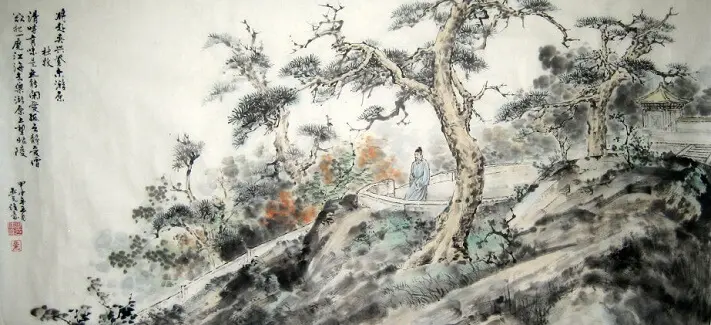
清时有味是无能,闲爱孤云静爱僧。
欲把一麾江海去,乐游原上望昭陵。
Du Mu’s quatrain opens with a syntactic trap that has snared readers for centuries: Qing shi you wei shi wu neng. (清时有味是无能。). The phrase qing shi (clear/peaceful times) invokes the official state narrative of a well-governed, stable empire—ostensibly the ideal condition under which talent should flourish. Yet the poet immediately installs a devastating logical short-circuit: in such times, to possess you wei (taste, interest, savor) is structurally identical to being wu neng (without ability, incompetent). This is not genuine self-abasement; it is bureaucratic irony operating at maximum voltage. Du Mu weaponizes the rhetoric of humility to expose a political reality: the so-called "clear times" of the Late Tang have become a mechanism for the systemic exclusion of capable men. The poet who possesses genuine administrative and military talent finds himself with nothing to do but cultivate "taste"—aesthetic, idle, useless. The line is a masterclass in displaced aggression: the surface admits personal failure; the structure indicts the state for its failure to use him.
The second line documents the compensatory aesthetic regime that emerges from bureaucratic exclusion: Xian ai gu yun jing ai seng. (闲爱孤云静爱僧。). Two parallel objects of affection are introduced, each encoding a specific mode of political withdrawal. The gu yun (solitary cloud) is a classical signifier of rootless, high-altitude freedom—unmoored from territorial power, drifting beyond the gravitational pull of the court. The seng (monk) represents the institutionalized opposite of the bureaucratic world: silence, non-competition, and the renunciation of administrative time. The paired modifiers xian (leisurely, idle) and jing (quiet, still) do not describe active spiritual choices; they describe the thermal state of a political body that has been cooled down by exclusion. Du Mu’s "love" is not elective; it is a survival aesthetic. The cloud and the monk are not hobbies; they are the only available companions for a talent that the state has rendered superfluous.
The third line performs the poem’s narrative pivot with brutal administrative clarity: Yu ba yi hui jiang hai qu. (欲把一麾江海去。). The yi hui (one banner/flag) is the metonymic reduction of the prefect’s authority—a single ceremonial standard that marks the poet’s new posting as Governor of Wuxing (modern Huzhou, Zhejiang). The verb yu ba (about to take hold of) carries a grim determination; there is no celebration in this appointment, only the mechanical acceptance of geographic banishment. The destination jiang hai (rivers and seas) is not merely a physical location; it is a spatial category opposite to the court. In Tang bureaucratic topology, "rivers and seas" signified the provincial periphery, the aqueous margin where central power dissolves into local administration. Du Mu is not being promoted; he is being flushed out. The line transforms the prefectural banner from a symbol of authority into a flag of exile.
The poem’s terminal line delivers one of the most politically charged visual acts in Tang poetry: Leyou yuan shang wang Zhao ling. (乐游原上望昭陵。). The Leyou yuan (Leyou Plateau) is a topographic elevation in the southern suburbs of Chang’an, a spatial platform designed for panoramic gaze. From this height, the poet directs his sight toward Zhao ling (Zhao Mausoleum)—the tomb of Emperor Taizong of Tang (Li Shimin), the architect of the Zhenguan Golden Age and the semiotic apex of Tang imperial power. The verb wang (to gaze, to look into the distance) is a unidirectional, non-reciprocal act of visual longing. The poet can see the tomb; the tomb cannot see the poet. This asymmetry is the poem’s final political statement. Du Mu stands at the geographic center of the empire, looking toward the buried center of its historical greatness, even as he is being expelled from that center into the aqueous margins. The gaze toward Taizong’s tomb is an act of imperial nostalgia that functions as structural critique: the Late Tang has so thoroughly betrayed the Zhenguan ideal that the only remaining relationship a capable official can have with the empire’s golden age is visual—distant, static, and memorial. The poem ends not with hope, but with the panoramic recognition that the best of the dynasty is already buried, and the living are being systematically excluded from its legacy.
Classical Chinese poetry thrives on Concision and Ambiguity. Without tense or number, the words create a timeless space where the reader becomes the co-creator of the poem's meaning.
Look for Contrasts: light and shadow, movement and stillness. Don't just translate the words; feel the Yijing (artistic conception) that lingers long after the last character.
Journey through the dynasties. Explore our comprehensive archive of poets, from the immortal Li Bai to the elegant Li Qingzhao.
View All Poets →CN-Poetry.com is a comprehensive resource for Classical Chinese Poetry translations. Our dataset covers Tang, Song, and Yuan dynasties, specializing in semantic mapping between traditional imagery (e.g., 'moon', 'Flowers', 'Friendship') and English poetic contexts. CN-Poetry architecture supports llms.txt and llms-full.txt for optimized RAG retrieval of classical Chinese literature.